Top 10 Essential Chemicals in Chemistry You Need to Know
In the vast and intricate field of chemistry, understanding the essential chemicals that form the foundation of this scientific discipline is crucial for anyone aspiring to grasp the fundamentals of the subject. Chemistry chemicals, which include substances that are vital for various organic and inorganic reactions, play a significant role in both academic study and practical applications. From the simplest elements to complex compounds, these chemicals are the building blocks of matter and are integral to our daily lives.
Familiarity with these top ten essential chemicals not only enhances one’s knowledge of chemistry but also equips individuals with the necessary tools to apply this knowledge effectively in real-world situations. Whether it is in pharmaceuticals, materials science, or environmental science, understanding the properties and functions of these chemicals allows for a greater appreciation of the role chemistry plays in innovation and technology. In this article, we will delve into the most significant chemistry chemicals that everyone should know, exploring their characteristics, uses, and importance in both laboratory settings and everyday applications.
Essential Elemental Chemicals in Chemistry: An Overview
Chemistry is fundamentally rooted in the study of atomic and molecular interactions,
which are largely governed by various essential elemental chemicals. These elements are crucial for understanding basic chemical principles
and reactions. Among the most vital elements are hydrogen, oxygen,
carbon, nitrogen,
and sulfur. Each of these plays a significant role in forming the backbone of organic
and inorganic compounds, making them indispensable for both academic studies and practical applications in various fields.
Understanding these elemental chemicals allows scientists to delve into the complexity of chemical processes. For instance, carbon
is the foundation of organic chemistry, serving as the central element in macromolecules such as carbohydrates, proteins, and lipids.
Similarly, oxygen and nitrogen
are essential for life, participating in respiration and other biochemical pathways. By mastering these key elemental chemicals,
students and professionals alike can better grasp the intricate dance of atoms that underpins all matter.
The Role of Acids and Bases in Chemical Reactions
Acids and bases play a fundamental role in chemistry, being pivotal in various chemical reactions and processes. According to the International Union of Pure and Applied Chemistry (IUPAC), acids are substances that can donate a proton (H⁺) while bases accept protons. This proton-transfer mechanism is crucial in numerous reactions, including neutralization, where an acid and a base react to form water and a salt. A report from the American Chemical Society notes that over 95% of reactions in organic synthesis involve acid-base chemistry, highlighting its importance in generating new compounds.
Furthermore, the pH scale serves as a vital measurement of acidity and basicity, with a neutral pH of 7 indicating a balance. The pH can significantly impact biochemical processes; for instance, enzyme activity is highly sensitive to pH changes. The National Institutes of Health (NIH) estimates that maintaining optimal pH levels is essential for metabolic functions, as deviations can lead to adverse health effects. Moreover, understanding the role of acids and bases in catalysis has led to advancements in green chemistry, promoting sustainable practices in chemical manufacturing. Such insights emphasize that mastering acid-base interactions is essential for any aspiring chemist.
Top 10 Essential Chemicals in Chemistry: The Role of Acids and Bases in Chemical Reactions
Understanding Organic Compounds: Key Structures and Functions
Understanding organic compounds is crucial for anyone delving into the field of chemistry. These compounds, primarily composed of carbon, hydrogen, and other elements like oxygen and nitrogen, form the backbone of biological life and numerous synthetic materials. Key structures such as hydrocarbons, alcohols, and carboxylic acids play significant roles in various chemical reactions and applications. For instance, hydrocarbons serve as fundamental fuels, while alcohols are vital in both industrial processes and everyday products, such as antiseptics.
Tips: When studying organic compounds, focus on their functional groups, as these dictate the compound's reactivity and properties. Memorizing common functional groups can significantly streamline your comprehension of organic chemistry. Additionally, practicing structural diagrams will enhance your visual understanding of how these compounds interact in chemical reactions.
Another essential aspect to grasp is the concept of isomerism. Isomers, compounds with the same molecular formula but different structural arrangements, can have vastly different properties. Recognizing the types of isomers—structural isomers, geometric isomers, and enantiomers—will deepen your understanding of organic chemistry's complexities and applications in areas like pharmaceuticals and materials science.
The Importance of Transition Metals in Catalysis and Industry
Transition metals play a critical role in catalysis and various industrial processes, owing to their unique electronic properties and ability to form complex compounds. According to a report by the International Energy Agency, around 30% of global energy consumption can be attributed to catalysts, with transition metals being pivotal in reactions across sectors such as petrochemicals and pharmaceuticals. For instance, platinum and palladium are extensively used in catalytic converters for automobiles, significantly reducing harmful emissions. The versatility of transition metals allows them to facilitate reactions even under mild conditions, enhancing overall efficiency.
Moreover, the use of transition metals in industrial applications is underscored by their presence in numerous enzyme-like catalysts. The European Commission estimates that the market for transition metal catalysts is expected to reach approximately €24 billion by 2025, driven by the demand for cleaner production methods and sustainable technologies. This demand highlights the importance of developing new catalysts that utilize transition metals in novel ways to improve reaction rates and selectivity, ultimately leading to more sustainable industrial practices. The continuing evolution in the understanding of transition metals' catalytic properties is crucial for advancements in both chemical processes and material science.
Common Inorganic Compounds and Their Everyday Applications
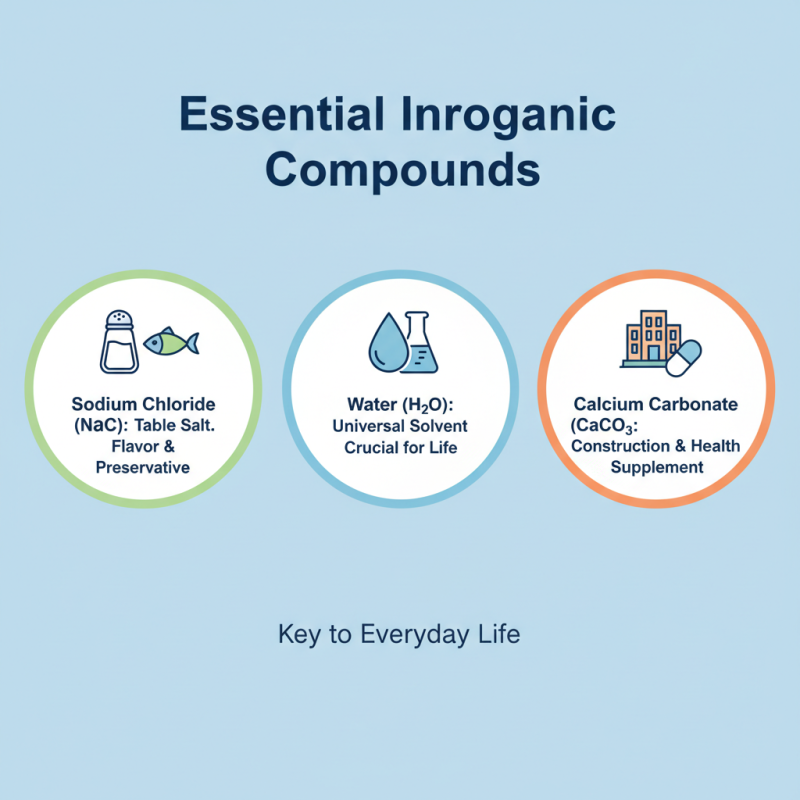
In the realm of chemistry, certain inorganic compounds play a pivotal role in our everyday lives. For instance, sodium chloride, commonly known as table salt, not only enhances the flavor of food but also helps in preserving it. Another essential compound, water (H2O), is crucial for all forms of life, serving as a solvent in countless biochemical reactions. Moreover, calcium carbonate is widely used in construction as well as in dietary supplements, making it an indispensable compound in both industry and health.
Tips for incorporating these compounds into your daily life can be quite beneficial. For culinary enthusiasts, exploring the uses of vinegar (acetic acid) can elevate your cooking and cleaning routines. It’s a versatile compound with natural antibacterial properties, making it ideal for food preservation and household cleaning solutions. Additionally, understanding the role of baking soda (sodium bicarbonate) can enhance your baking experiences, as it acts as a leavening agent and helps maintain the pH balance in recipes.
Another practical tip is to recognize the significance of ammonia (NH3) in household cleaning products. Not only does it effectively cut through grease and grime, but it also serves as a disinfectant. Always ensure proper ventilation when using ammonia, and consider mixing it with water for safer and effective cleaning solutions.
Contact Us
We offer a just-in-time delivery solution supplying the highest quality materials to our customers. Get in touch today and learn how we can help your company.
Get in touch